AI is everywhere in marketing right now, especially in content. Tools promise instant insight, automated curation, and feeds that magically stay relevant without human effort. That sounds efficient, but it hides a quiet problem. Curation is not about collecting information. It is about judgment, intent, and context.
AI can process volume at scale, but it cannot understand why something matters to a specific audience at a specific moment. That limitation is often framed as a weakness to be solved. It should be framed as an advantage.
For marketers who actually understand their audiences, AI’s inability to curate well creates space for differentiation. When everyone can generate content, taste becomes the competitive edge.
Curation Requires Taste, Not Just Pattern Recognition
AI is excellent at spotting patterns across massive datasets. It identifies trending topics, frequently linked sources, and content formats that historically perform well. What it cannot do is develop taste.
Taste comes from lived exposure, professional instinct, and an understanding of nuance that is not explicitly stated in data. When a human curator chooses a piece of content, they are making a layered decision that includes tone, timing, subtext, and relevance beyond keywords.
Pattern recognition favors what already exists and what already performs. That makes AI curation inherently conservative. It amplifies the loudest signals and reinforces dominant narratives.
Human curation often does the opposite. It elevates emerging ideas, contrarian takes, or underappreciated sources before they become obvious. That leap cannot be derived from historical performance alone.
This difference matters in marketing because audiences do not follow brands for averages – they follow them for perspective. A well-curated feed feels intentional, not optimized. It reflects a point of view that signals competence and discernment. AI can simulate relevance, but it cannot originate judgment. That gap is precisely where smart marketers still win.
Context Is Invisible To Algorithms And Obvious To Humans

Curation lives and dies on context. The same article can be insightful, irrelevant, or actively harmful depending on when and why it is shared. AI systems struggle here because context is rarely explicit. Market sentiment, audience fatigue, cultural tension, and industry politics are not clean data points, no matter how many Taboola alternatives you go through.
A human marketer understands when a topic has been overdiscussed, when an audience is burned out, or when silence is more strategic than amplification. AI does not feel saturation. Right off the bat, it sees engagement and assumes value, despite not being able to provide any. That leads to feeds that are technically relevant but emotionally tone deaf.
Context also includes intent. A curator is not just answering the question “what is this about” but “why does this matter right now.” That requires an understanding of audience goals and anxieties that extends beyond behavioral data. Humans infer these signals through conversation, feedback, and experience. Algorithms infer them through proxies, which are often delayed or misleading.
For brands, this distinction is critical. Misaligned curation erodes trust quickly. Aligned curation builds it quietly over time. AI can assist with discovery, but final judgment still depends on human awareness of situational meaning.
Algorithms Optimize For Engagement, Not Understanding

Most AI-driven curation systems are optimized around engagement metrics. Clicks, dwell time, shares, and recency become stand-ins for quality. That optimization creates a subtle but consistent distortion.
Human curators are not immune to this pressure, but they can consciously resist it. They can choose depth over immediacy and relevance over novelty. They can curate content that challenges their audience rather than merely entertaining it. AI lacks that discretion because it does not understand the long-term relationship between brand and audience.
This is why AI-curated feeds often feel noisy. They surface content that performs well in isolation but lacks cohesion as a whole. Human curation considers the feed itself as a narrative. What has already been said, what is missing, and what should come next all matter.
There’s an opening here, too. A thoughtfully curated stream signals confidence and can even reshape other avenues like media buying and social media exposure. It shows the brand is not chasing every spike but is guiding attention with intent. AI can generate momentum, but humans create meaning.
Original Curation Builds Authority In A Way Automation Cannot
Authority is not built by volume, nor by the extent of AI use in your content strategy. It’s built on consistent, credible selection. When an audience sees that a brand regularly surfaces content that makes them smarter, they assign trust. That trust is tied to perceived judgment, not technical capability.
AI-generated curation struggles here because it is interchangeable. If multiple brands use similar tools trained on similar data, their outputs converge. Feeds begin to look and feel the same. Differentiation collapses, and authority becomes diluted.
Human curation introduces idiosyncrasy. Two skilled marketers can look at the same information landscape and surface entirely different narratives. That divergence is valuable. It gives audiences a reason to choose one voice over another.
This is especially important in B2B and niche markets, where audiences value signal over scale. A small number of well-chosen insights can outperform a constant stream of automated recommendations. AI can support research and discovery, but authority still depends on visible human judgment.
AI Works Best As A Filter, Not A Curator
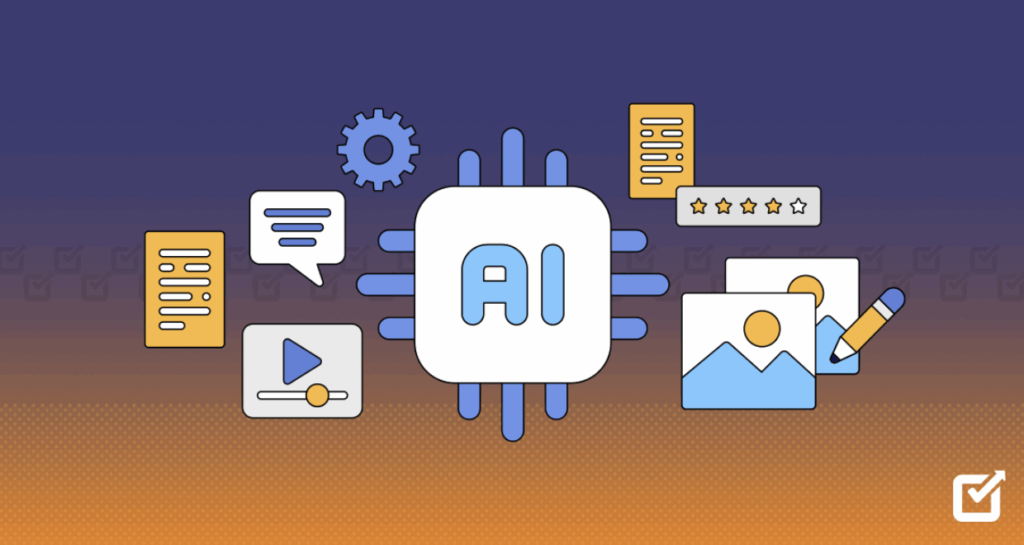
The productive role for AI in curation is upstream, not at the point of selection. It excels at scanning, clustering, and summarizing large volumes of information. Used correctly, it reduces cognitive load and expands awareness. Problems arise when AI replaces decision-making instead of informing it.
Smart marketers treat AI as a filter that narrows the field, not as a voice that speaks for the brand. They use it to surface possibilities, then apply human judgment to decide what aligns with their audience and strategy. This hybrid approach combines scale with taste.
The future of effective curation is not fully AI-aided and not purely manual. It is collaborative, with AI handling abundance and humans handling meaning. Brands that understand this will stand out as others blend into algorithmic sameness.
Final Thoughts
The fear around AI in marketing often assumes replacement. In curation, the reality is separation. AI will continue to improve at aggregation and prediction, but curation is fundamentally about interpretation. That skill does not scale the same way computation does.
For smart marketers, this moment rewards restraint and clarity. Let AI handle the noise. Use human judgment to decide what deserves attention. That combination creates feeds that feel calm, credible, and useful.
The good news is not that AI is limited. The good news is that those limits preserve the value of human perspective. In a landscape defined by abundance, curation becomes an act of leadership rather than logistics.

 (4 votes, average: 4.50 out of 5)
 Loading...