

Strong content marketing drives exceptional results. But for it to do so, it needs to be built around the customer.
In 2026, customer-centricity is no longer a nice-to-have. Instead, it’s one of the first things consumers ask for when deciding whether they want to engage with brands in the first place.
There’s data suggesting that eight in ten web users actively ignore irrelevant marketing messages. Furthermore, studies reveal that 83% of people want brands to present them with personalized shopping experiences, and 74% feel more likely to purchase following personalized brand interactions.
But the simple truth is that the power of customer-centricity doesn’t just lie in elevating conversion rates. It could be equally powerful in ensuring high marketing ROIs, particularly in saturated markets where brands have to compete for consumer attention, engagement, and interest.
Are you looking to take your content marketing efforts to the next level? In that case, building your resource library around your ideal customers could be the way to go.
Here are some lesser-known content marketing tactics that will help you align your content production and distribution efforts with what consumers truly seek, enabling you to delight your audience and effectively draw them into your sales funnel.
Start with Customer Insight
High-performing content is always hyper-relevant. However, if you want to produce resources that matter to your target audience, you’ll first need an in-depth understanding of your ideal customers.
This strategy works because it gives you an opportunity to optimize your content marketing efforts (in terms of maximizing ROI and preventing unnecessary spending). More importantly, starting with customer insights demonstrates to your target audience that interacting with your business is the right decision in their attempts to resolve their pain points.
If you’re not entirely convinced that basing your content marketing strategy on customer insights works, just consider the following:
- 73% of consumers expect companies to understand their unique needs and expectations.
- 79% of people say that a brand needs to first demonstrate that it understands and cares about them to even consider purchasing.
With this in mind, do your best to learn what your customers care about (or what their fears, struggles, and pain points consist of). Do qualitative research on the questions existing clients have been asking your support team. Identify customers’ emotional purchase drivers and learn about your audience’s aspirations. That way, you can base your content marketing on addressing those wants instead of having to rely on aggressive sales tactics.
CodaPet, for example, does a tremendous job of publishing customer-centric content on its blog. The brand has an exceptionally thorough understanding of its ideal customers’ emotional concerns. By identifying these elements of its audience’s experience, Coda Pet is capable of composing content that’s empathetic and emotionally relevant. Moreover, by delaying mentions of its service, the business demonstrates compassion, effectively earning its visitors’ trust, reducing their skepticism, and ensuring that readers perceive its offer as genuinely relevant to their needs.
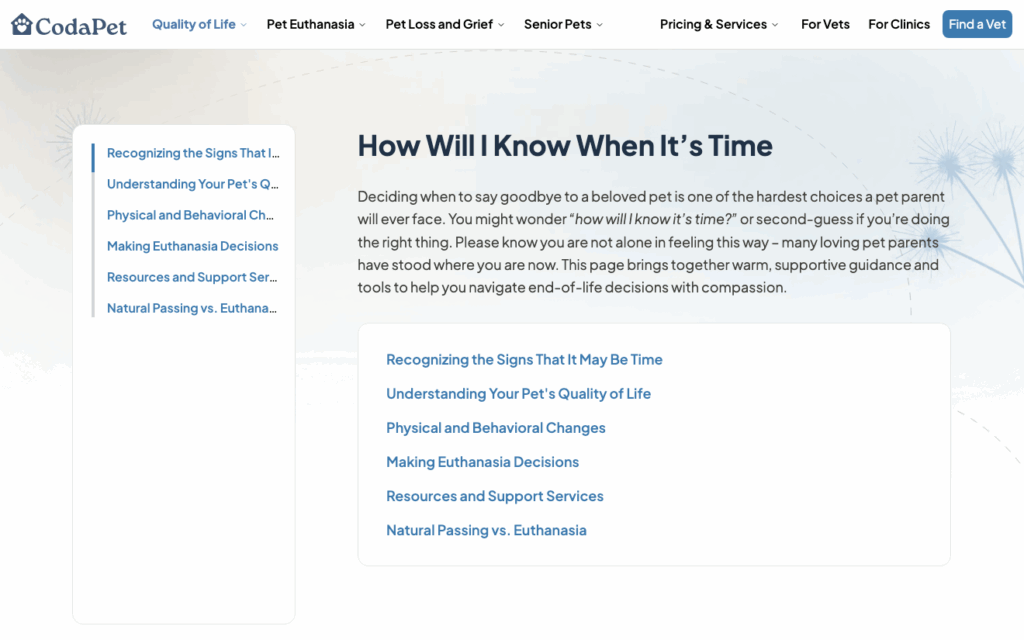
Source: codapet.com
Align Content with the Buyer Journey
It’s true that quality is a direct predictor of the success potential of your content marketing strategy. Nevertheless, it’s essential to remember that great content won’t drive conversions unless it aligns with your target audience’s current position within the buyer’s journey.
Ultimately, consumers go through several stages while researching and evaluating potential solutions to their pain points. More importantly, their informational needs vary greatly across the different phases of the sales funnel.
For instance, customers in the awareness stage will only start realizing that they have a specific pain point. Bombarding them with conversion-oriented resources won’t just fail to move them through the sales cycle. It may even alienate them, causing them to leave your marketing funnel and choose to engage with your competitors instead.
Are you trying to align your content strategy with your target audience’s wants and needs? In that case, you’ll want to produce separate resources for each stage of the buyer’s journey.
- Begin by mapping out your prospect’s specific intent at each stage of the funnel.
- Be very gentle about nudging readers from one phase to the next.
- Build logical pathways from awareness to conversion so that your audience doesn’t feel pressured or overwhelmed to make a buying decision before they’re genuinely ready for one.
For example, look at how Mind Lab Pro incorporates this content tactic into its online presence. Knowing that readers are likely still in the research phase when reading the Mushrooms as Medicine article, this brand strongly prioritizes educational value over conversion pressure.
Yes, it does use internal links to encourage web visitors to browse on-site content and product pages. But from start to finish, this article focuses solely on education, aligning with the awareness stage of the buyer’s journey and effectively earning readers’ trust in the process (by avoiding a hard sell).

Source: mindlabpro.com
Make Complex Topics Easy to Understand
For many businesses, high-quality content production presents a valuable opportunity to establish brand competence and credibility. However, the mistake they often make is trying to prove expertise through complexity.
Ultimately, covering complicated topics (that are relevant to a specific target audience) and demonstrating your understanding of how to resolve common pain points related to those topics can lead to impressive marketing outcomes. But, there’s one condition: the content itself cannot be overly complex in a way that makes it inaccessible.
In 2026 and beyond, consumers want brands to present them with convenient buying experiences. And many shoppers — 77%, according to a 2024 study — are willing to pay a convenience premium of up to 5% if it means solving their needs with ease.
So, while this data indicates that convenience-based user-centricity pays off in terms of sales performance, it’s equally important to understand that accessibility also impacts marketing ROI.
If you want to invest in customer-oriented content that drives sales, here’s what you have to do:
- Prioritize effortless understanding in the resources you publish.
- Avoid niche jargon and try to use easy-to-understand terms (or provide explanations for niche terms).
- Optimize your content for readability.
- Adhere to accessibility-boosting web design standards.
- Don’t hesitate to experiment with content formats (like visuals and videos) that boost comprehension.
If you check out Uproas, you’ll find that this business does a tremendous job of building content around the customer. This brand’s Ultimate Guide to TikTok Pixel Setup simplifies a technical topic with plain language. It uses a scannable layout to maximize user engagement and attention. Plus, it places a clear visual emphasis, highlighting the next steps for readers who are ready to move to the next phase of the funnel.
This approach removes friction instead of adding complexity. Furthermore, it results in an overall enjoyable content consumption experience that boosts product understanding and elevates brand perception in terms of user-centricity.
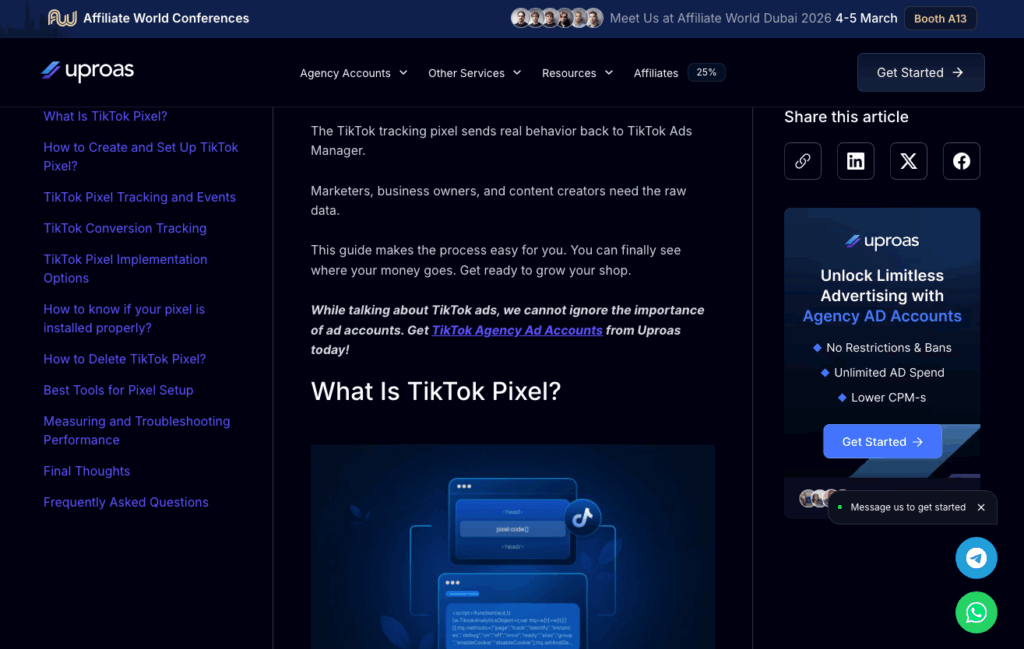
Source: uproas.io
Keep Messaging Consistent Across Channels
Another content marketing tactic that removes customer friction and optimizes for user-centricity is publishing across multiple channels.
Now, the logic behind this is relatively simple. While consumers commonly use brands’ websites to conduct pre-purchase research, their buying journeys usually begin off-site. In fact, in 2026, social media remains one of the most common places people discover and engage with businesses.
So, to ensure your content marketing efforts yield impressive results, prioritize consistency and alignment across all of your distribution channels. That way, you’ll:
- maximize brand trust through consistent positioning
- avoid consumer confusion due to misalignment
- reinforce brand familiarity and recall, both of which are essential in influencing consumers’ future buying decisions
But which aspects of messaging consistency are best to pay attention to when aiming for customer centricity?
Start by developing several core value propositions. Ensure you repeat these throughout your online presence (including your website, blog, social media, and ads). Maintain consistency regarding your tone of voice. Lastly, remember to align all content types — especially across visual and text-based formats.
If you check out Purscents, you’ll find that its social media and blog content rests in perfect visual and tonal harmony. In addition to using the same language and multimedia across channels, this brand also focuses on covering topics that genuinely matter to its eco-conscious target audience. The outcome of this approach includes a highly customer-oriented content strategy that delights customers and, more importantly, builds brand preference too, thanks to a strong commitment to cross-channel consistency.

Source: instagram.com
Balance Emotion and Logic
While some resources suggest prioritizing emotional impact within your marketing strategies, it’s crucial to remember that logic plays an equally important role in driving engagement and conversions.
Yes, 95% of all buying decisions are subconscious and driven by emotional factors. Furthermore, it is true that consumers tend to buy more from brands with which they feel connected. However, when developing high-performing content strategies that guide customers through the sales funnel, it’s impossible not to account for the rational, evaluation-oriented aspect of the decision-making process.
That’s why your customer-centric content should find a balance between emotion and logic.
A good rule of thumb is to identify and address the emotional aspirations driving your target audience’s purchase intent. Then, explore opportunities to encourage those aspirations with logical reasoning. You can use this with strategic storytelling or urgency triggers. What matters most is that you avoid manipulation, as that’s only likely to provide short-lived conversion lifts and might result in a loss of customer trust.
For example, if you check out IceCartel, you’ll find that this brand does an amazing job of producing content that incorporates both emotion and logic. To engage its ideal customers, this brand emphasizes the emotional value of its jewelry. It reminds readers that engagement rings are a physical representation of the promise they symbolize. On top of all that, it validates customers’ aspirations by stating that their partners genuinely do deserve the best.
However, what Ice Cartel does splendidly is that it supports these claims with practical considerations. It guides buyers through the process of making smart purchase decisions that align with their needs and lifestyles. Furthermore, it provides generous advice on choosing the right stones and materials, even mentioning options such as moissanite, knowing that they can significantly reduce cost without sacrificing looks or durability.
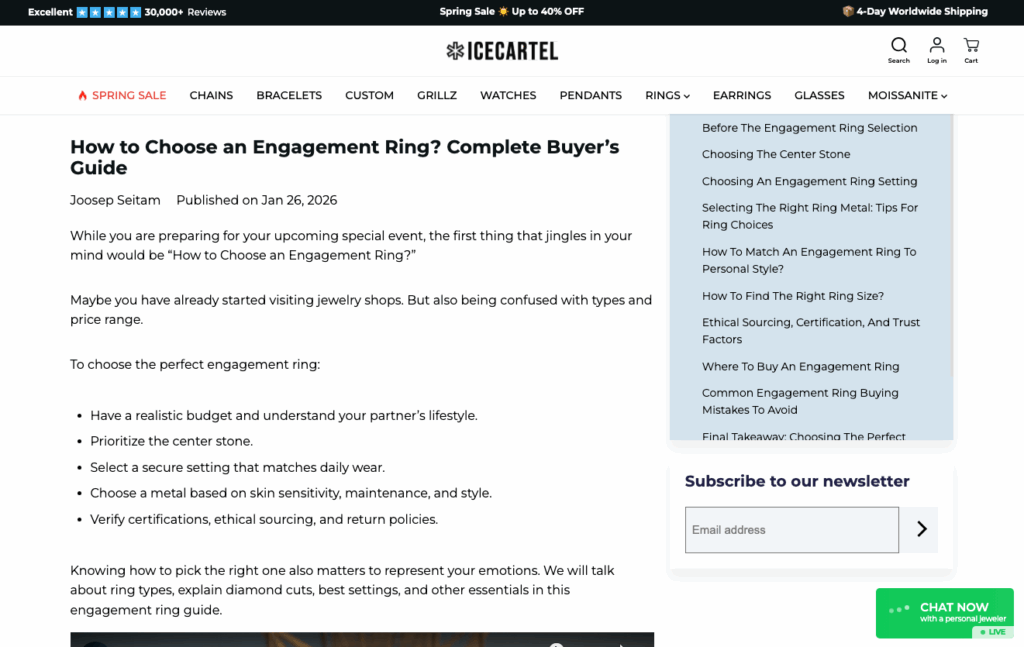
Source: icecartel.com
Build Trust Before Selling
If you want to invest in high-performing content that drives engagement and elevates conversion rates, it’s crucial that you comprehend what it is that makes consumers want to buy from a business in the first place.
In 2026, trust remains one of the most powerful factors influencing purchase decisions. In fact, research suggests that it’s equally important as price and product quality.
Interestingly enough, brand trust doesn’t just determine shoppers’ willingness to buy specific products. It also influences how much they’re prepared to pay, with new findings suggesting that 68% of shoppers would spend more on products they trust.
What this buyer behavior indicates — especially when developing a content marketing strategy built around the customer — is that user-oriented resources must prioritize credibility and reassurance before pushing sales.
The great news is that incorporating trust-enhancing elements into the content you distribute can be relatively easy. In addition to incorporating proof into your resources, explore additional opportunities to enhance customer confidence with transparency, clear (and objective) differentiators, and risk-addressing resources that handle common conversion obstacles.
Custom Sock Lab has an exceptional approach to producing trust-building customer-centric content, which you can see on its CSL Difference landing page. Here, the brand addresses all the potential reasons web visitors wouldn’t feel comfortable converting into customers, emphasizing transparency, proof, and differentiators.
This approach builds confidence. And only when it’s one hundred percent certain that it has convinced readers of its trustworthiness does Custom Sock Lab prompt action with a CTA button.
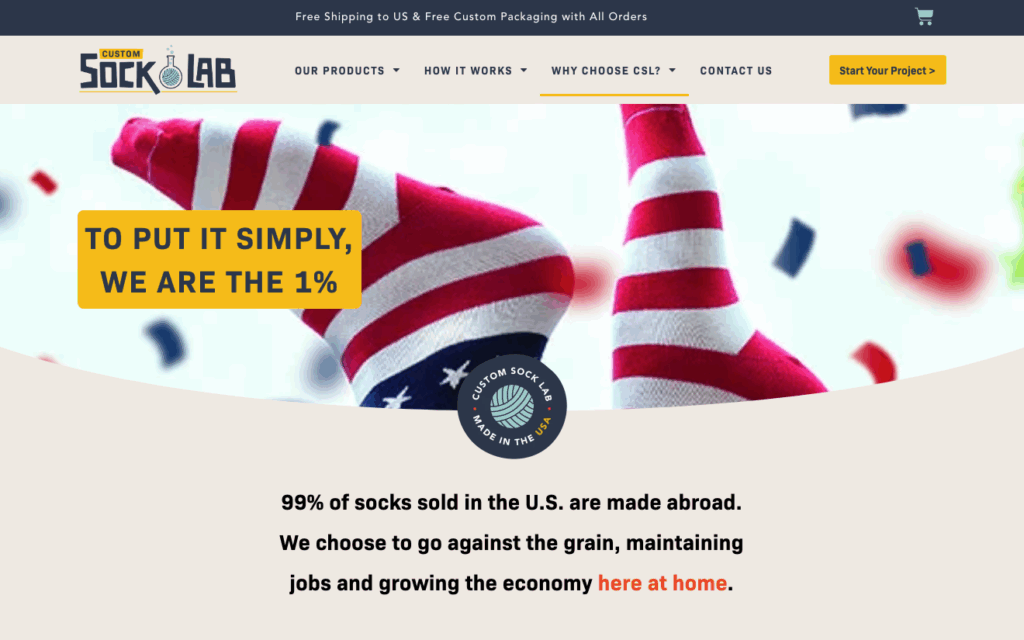
Source: customsocklab.com
Use Social Proof with Purpose
So far, we’ve established that a trust-based approach effectively supports businesses in creating strong, customer-centric content. However, speaking about trust and credibility is practically impossible without reflecting on the content format that drives the highest level of trust — social proof.
As a user-generated type of content that supports brand claims with real-life effectiveness evidence from existing customers, social proof plays a major role within the typical buyer’s journey. According to consumer behavior research, the vast majority of shoppers consult some form of social proof before deciding to buy. Even more importantly, 45% of people won’t even consider a purchase if a solution doesn’t have any reviews available for it.
From a conversion-oriented standpoint, there’s practically no wrong way to utilize social proof. However, when aiming for customer-centricity, it’s essential for the UGC you incorporate into your online presence to be purposeful.
So, how do you do this in a way that encourages trust and drives conversions? You can start by matching highlighted testimonials to reader intent, that is, using social proof to prove your brand’s credibility in the context most relevant to your target audience. Moreover, explore opportunities to embrace specificity, seeing that numbers and user-submitted visuals hold particular weight in driving credibility. Finally, utilize social proof for its ability to remove doubt in key points of the sales funnel, particularly around decision moments such as your primary CTAs.
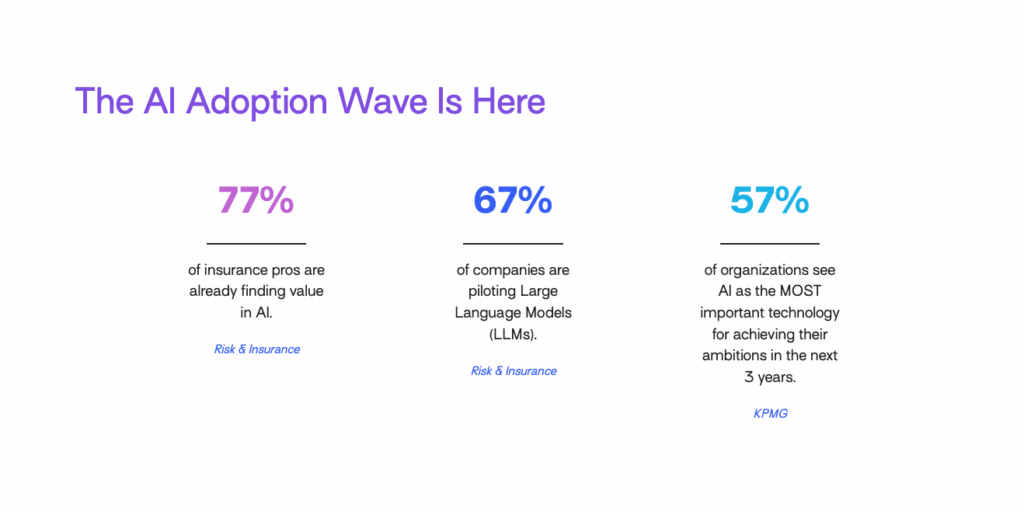
For example, the Applied Systems content pages — like the Next Generation Insurance infographic — heavily feature numbers-based social proof. What’s fascinating about this brand’s approach to building trust and removing conversion obstacles isn’t simply that it supports its claims with evidence. Much more importantly, it specifies the source from which this evidence was collected, adding a much-needed level of transparency and credibility to an already high-value resource for evaluation-stage customers.
Source: appliedsystems.com
Address Objections Proactively
Strong content understands what consumers need. This includes anticipating their objections, doubts, and hesitations and addressing them in a way that builds clarity and empowers buyers to make smart buying decisions.
By using your content to proactively tackle customer objections, you won’t just reduce your audience’s likelihood of slipping out of your sales funnel. You’ll also create a sense of security and confidence. This will allow your prospects to navigate the buyer’s journey without fear, encouraging them to associate that feeling of safety with your brand.
To address the right objections — the ones that matter the most to your target audience:
- Identify your client’s most common doubts and questions.
- Study your competitors and how your offer compares (with honesty).
- Do your best to incorporate data into any objection-removing content, to provide your clients with reassuring transparency.
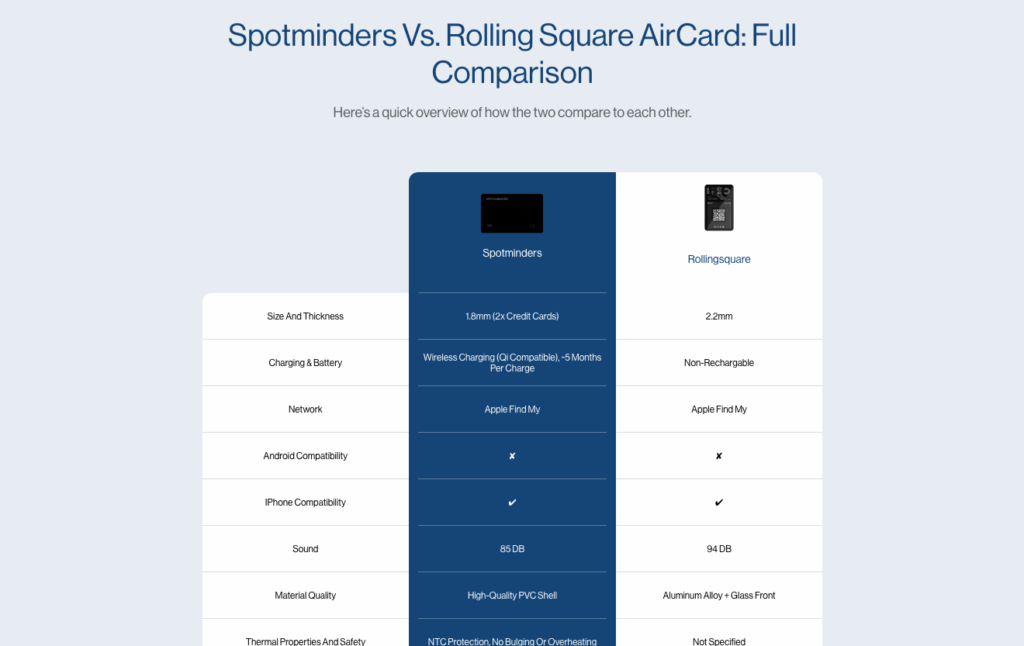
For example, this Spotminders Comparison resource does all of these things. It directly confronts competitive questions. It reduces uncertainty to prevent it from harming purchase intent. Lastly, it creates a fair framing for the juxtaposition of the two product options, ensuring that consumers genuinely benefit from it (and don’t walk away feeling like they’ve just interacted with an advertisement).
Source: spotminders.com
Final Thoughts
Strong content marketing is always customer-centric. And while it may not always be obvious, it is indisputably true that high-performing content has to meet consumer needs.
The tactics discussed in this guide will help you inject a dose of that customer-centricity into your content efforts. Whether you choose to use all of these strategies or a select few is entirely up to you. In any case, you can rest assured that making a move toward customer-oriented content marketing will help you toward your goals as well as aid your attempts to position your brand and products as the best possible option for your ideal customers.
 (3 votes, average: 5.00 out of 5)
 Loading...